Terrace Cricket Net Guide: Size, Netting and Pole Planning
A terrace cricket net guide covering practice lane size, netting thickness, poles, wind loads and safe fixing on your roof before you build.
Want advice for your own balcony?
Send your details and we will call you to arrange a free site visit and a written quote.
- Call us
+91 63010 19626 - Hours
Open 24 hours for enquiries
A cricket net on the terrace is one of the best ways to give a young player daily practice without leaving home. It keeps the ball inside, protects neighbours’ windows and lets a batter face bowling all evening. But a poorly planned terrace net can sag, sway or damage the roof. This guide explains how to plan the size, the netting and the poles so the net is safe, durable and useful.
Start with the roof, not the net
Before you think about size, check what the terrace can carry. Poles apply load to the slab, and wind pushes hard on a large net at height. A sound reinforced concrete roof can usually take a well-designed frame, but an older or thinly built roof may need special base plates or a lighter design. A good installer inspects the slab and parapet first and tells you honestly if the roof is unsuitable.
Choosing the size
Practice lanes are long and narrow. The right size depends on the space you have and the level of the player.
- Length: longer is better. A short lane limits the run-up for a bowler and cuts down the flight of the ball. If you can fit a lane long enough for a bowler to run in, do so; if not, a shorter lane still works well for batting and fielding drills.
- Width: a lane wide enough for the batter’s stance and a full swing, plus room for the bowler and wicket-keeper if needed.
- Height: tall enough that a lofted shot cannot clear the top. A higher net catches more balls but also catches more wind, so height and pole strength must be planned together.
If your terrace is small, we will suggest a compact cage rather than a full lane, and explain what practice it does and does not allow.
Choosing the netting
The ball hits the net repeatedly and hard, so this is not the place for thin mesh.
- Twine thickness: thicker twine lasts longer and takes impact better. Practice lanes need thicker twine than boundary nets.
- Material: braided nylon or HDPE netting, ideally UV-stabilised so sun does not weaken it.
- Borders: a reinforced border prevents the edges from tearing.
- Colour: dark green or black is common because it is easy on the eyes and hides dirt.
Poles, cables and base plates
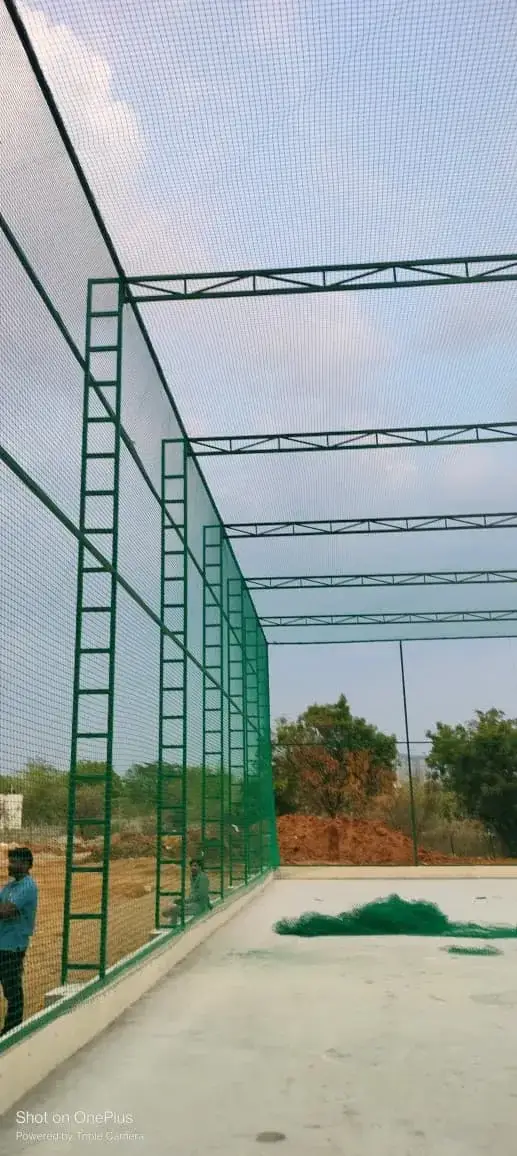
The frame is what keeps the net up. Poles should be rust-protected steel, set on base plates fixed into the slab or the parapet. A top cable, pulled tight between the poles, stops the net from sagging along the length. Mid-supports may be needed on long lanes. In Andhra Pradesh, where monsoon wind can be strong, a frame planned for gusts is much safer than one designed only for calm days. Our page on cricket practice nets explains the options for terraces, grounds and box cricket courts.
Access and safety
A door or opening for players, a safe route to the terrace and a non-slip floor are easy to forget. So is a plan for heavy rain and storms; ask whether the design allows the net to be lowered or loosened before severe weather. Keep spectators and other family members outside the swing area, and never let children climb on the poles or cables.
Planning your budget
The cost of a terrace cricket net depends on the length, width and height, the twine grade, the number and type of poles and the complexity of fixing to the roof. Two nets that look similar can be priced very differently because of the materials underneath. That is why we quote after a site visit, in writing, listing the netting, poles, cables and fixings.
Maintenance
Check the net for holes, the poles for movement and the base plates for loosening every few months. Patch small holes quickly; a hole grows fast under impact and wind. Brush off leaves and dust, and trim any tree branches that rub the net.
What to ask an installer
- Have you checked the strength of my roof?
- What twine thickness and material will you use?
- How will the poles be fixed and how will they cope with wind?
- Will I get a written quote listing every part?
If you are ready to plan your own terrace net, ask for a free site visit. We will measure the space, check the roof and give you a clear, written quote. If you also need protection on the same terrace, such as bird netting or safety nets, we can plan it together.